

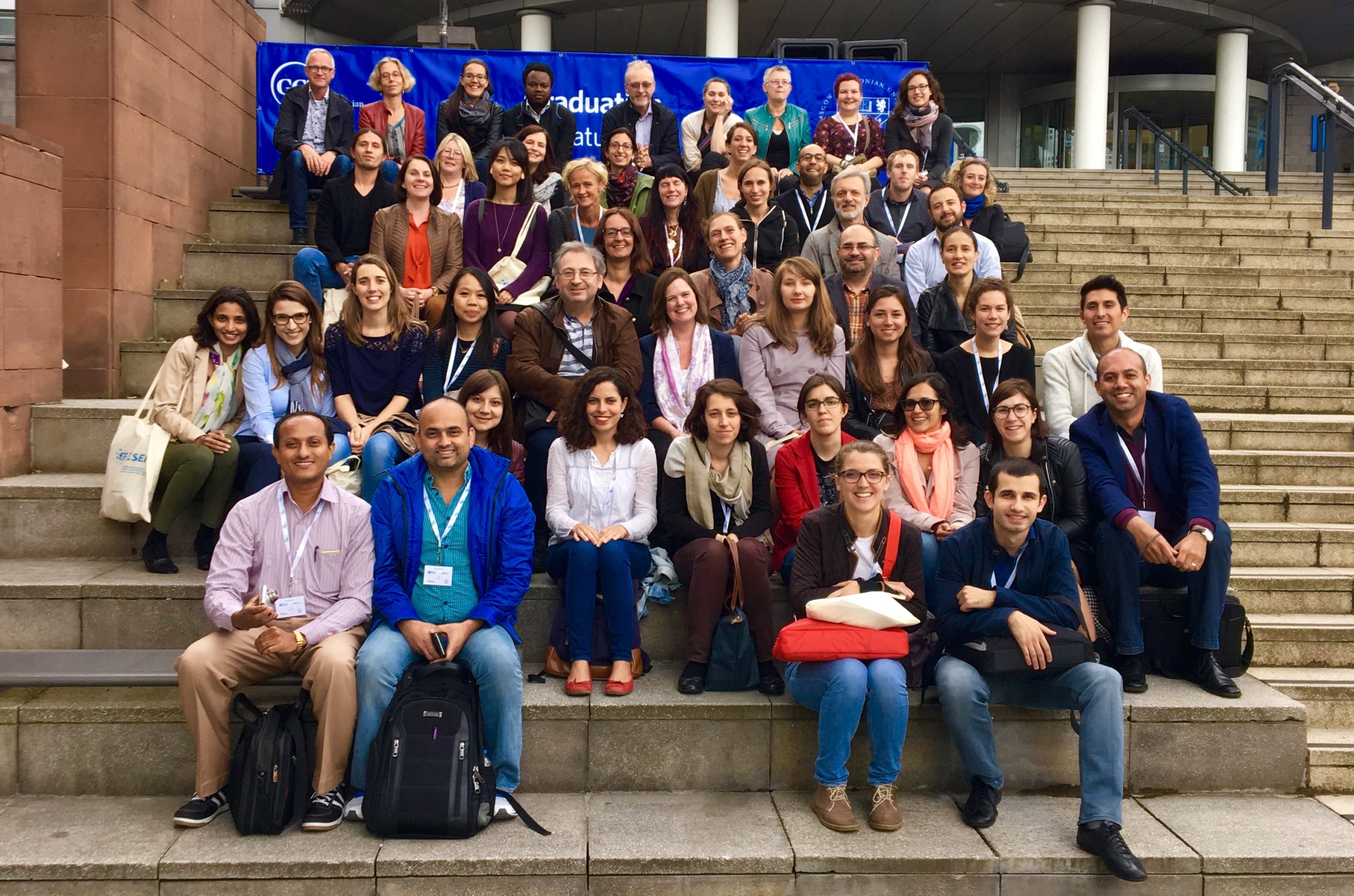
In this new interview, we speak with Paola Raffaelli, a long-time EMES member who first joined the community during the 2016 Training School in Glasgow. Nearly ten years later, Paola reflects on the profound impact that experience had on her academic career — from meaningful collaborations and international publications to enduring friendships and a sense of belonging in a vibrant research network.
She shares how EMES has helped shape her professional journey, foster cross-border cooperation, and strengthen a values-driven approach to research on social enterprise. This story is a testament to what long-term academic community and shared vision can build.
1. In 2016, you participated in the Training School in Glasgow. How would you describe its impact on your professional career and your connection with other EMES members?
Almost ten years later, I can confidently say that the Glasgow Training School had a huge impact on my career, even though at the time it was hard to foresee. It was there that I met Vicky Nowak, with whom I developed a lasting collaboration: we published our first article three years ago, recently submitted a second manuscript, and are already working on a third. We’ve also presented together at six or seven conferences, and I had the opportunity to be invited as a lecturer at her university. Without a doubt, that week of shared work in Glasgow was the starting point of a very fruitful professional relationship.
I also met other colleagues there with whom I’m still in touch. Over the years, we’ve reconnected at various EMES conferences and other academic spaces, which helped to strengthen these bonds. Many of us were at similar stages in our careers, sharing a common interest in social enterprises. Today, we remain connected, even through a WhatsApp group where we share job opportunities, teaching resources, and academic support.
2. You mentioned that you and Vicky became “writing partners” after the training. How did this collaboration come about, and what opportunities for joint work have emerged thanks to EMES?
Our collaboration started because we shared a working subgroup during the Training School. Although others were in the group, our research topics were very similar — both focusing on social enterprises in the UK — and we had supervisors who had already collaborated with each other. This made it easy to connect quickly.
Working side-by-side intensively for a week was key to establishing a strong professional bond. The depth and intensity of that initial collaboration laid the foundation for a relationship that has grown over time, leading to multiple publications, conferences, joint projects, and a friendship.
3. How do you think EMES has contributed to expanding your professional horizons? What value do you find in being part of such a diverse international network?

Being part of EMES allowed me to connect with scholars who share not only my interest in social entrepreneurship but also a perspective focused more on social change than on business management. This conceptual affinity has been invaluable to my professional development.
Moreover, EMES keeps me updated on the latest debates and emerging ways of understanding social entrepreneurship. One aspect I particularly appreciate is its diversity: despite being a European network, I’ve found more Latin American academics here than anywhere else, and I have always felt that the variety of perspectives and backgrounds is genuinely welcomed.
4. What challenges do you think EMES currently faces, and how can the network continue to grow and offer value to its members?
One challenge might be generational renewal. The network was founded by highly influential academics who are beginning to retire. However, over the years, new voices have organically emerged, keeping the network vibrant.
For me, the greatest value of EMES lies in the human quality of its interactions — long-term relationships built on shared values. In my experience, I haven’t found another academic network with this level of personal and professional commitment.
5. What advice would you give to new EMES members, especially PhD students, to make the most of the network and its collaboration opportunities?
Collaboration opportunities don’t just happen; they are built. But to make that happen, you have to be in the right place at the right time. My first advice is to actively participate in EMES’ meeting spaces. It’s an excellent way to meet interesting people, among whom you’ll surely find those who share your academic interests and with whom collaborations can develop.
My second advice is to dare to look for “writing partners.” This only happens through conversations with colleagues, exploring shared ideas, and finding points of convergence. An academic career can be lonely, and in a high-pressure environment focused on publishing, having colleagues to work with collaboratively, enjoy the process, and offer mutual support makes a huge difference. For me, EMES has been a key space for finding exactly that.